
What "The Sopranos" warned us about sports gambling
For the first time, the writer of the "Chasing It" episode explains Tony's descent into compulsive betting.

IN COLLEGE, I TOOK A COURSE on the Divine Comedy. We had to parse each line, and I used to fantasize about being able to ask Dante for help deciphering his symbolism. So, the leopard, she-wolf, and lion in the forest—what was that all about?
Spending an hour on the phone recently with Matthew Weiner, an executive producer of HBO’s “The Sopranos,” was similarly thrilling. (Granted, Dante died 700 years ago and Weiner is alive and well in Los Angeles, but still.) As with Dante, you get the sense watching that show that every detail and word of dialogue was chosen with enormous care. That’s especially true of an episode that Weiner wrote for the final season called “Chasing It,” in which the mob boss Tony Soprano descends into his own version of hell, overcome with desperation and rage as he loses hundreds of thousands of dollars over a frenzied stretch of sports betting.
It’s a subtle, nuanced depiction of what makes gambling seductive and, for some, so difficult to stop. For the first time publicly, Weiner—who went on to create “Mad Men”—was kind enough to discuss what inspired that storyline and what it sought to convey about greed, chance, and human weakness.
The episode debuted in 2007, but given everything that’s happened with sports gambling since, I don’t think Tony’s betting bender has ever been more resonant.
As Weiner explained, Tony is chasing a big payday, but it’s really about so much more than money.
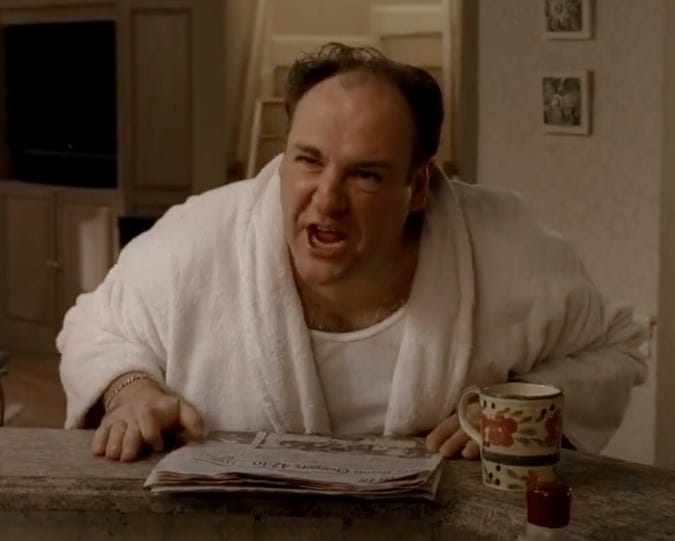
A man on a rough losing streak.
“Chasing It” falls toward the end of Season 6, just five episodes before the cut-to-black series finale. Gambling is a recurring plot point throughout the show—in Season 2, for instance, Tony’s guys allow the owner of a sporting goods store to rack up huge debts playing poker, then squeeze him so ruthlessly for the money that he eventually kills himself—but it seemed significant that an entire episode so close to the finale was devoted to Tony compulsively betting on sports.
By that point, the boss is boxed in from all sides. The feds have just exhumed the first person Tony ever killed (a bookmaker, coincidentally); tensions are rising with a rival New York crew; his marriage is faltering; and after one of Tony’s lieutenants, Vito, is brutally murdered for being gay, his widow begs Tony for $100,000 to relocate their family, since her distraught son is being mercilessly teased at school. Meanwhile, Tony owes his friend Hesh $200,000 that he borrowed to cover sports betting losses.
Weiner said the show’s creator, David Chase, assigned him the script because Weiner was the only person on staff intimately familiar with gambling. “I had a relative who was a compulsive gambler and had been in trouble his whole life,” he told me. “I remember asking him as he was chain smoking outside the house looking at the racing form, ‘Do you win?’ He was like, ‘Oh, I don’t care about winning. I just like the action.’
“That word action,” Weiner continued, “it doesn’t mean anything like that in any other context. It is literally about a physical sensation that has to do with risk in the moment, that thing that gives you the buzz. People talk about heroin that way as well—they’re chasing some experience.”
In a sense, that’s the entire premise of “The Sopranos”: a mobster despondent over the declining state of America and the decrepit state of organized crime, longing for the good old days. As Tony tells his therapist in the pilot, “Lately, I’m getting the feeling that I came in at the end. The best is over.”
By the final season, Tony “is emotionally overwhelmed and disappointed and afraid,” Weiner said. Much of that is because he feels powerless, realizing that so much of his life will be determined by luck. “How depressing is that?”
Somewhat counterintuitively, the urge to gamble—the ultimate form of submitting to chance—is often strongest in people who feel trapped, unable to influence the direction their life is going. As the British betting analyst Joseph Buchdahl once wrote:
Gambling, through hope and the repeated cycle of reward anticipation and disappointment, confirms that we are alive. Winning, moreover, confirms that we have left the realm of ‘nobody’ for the realm of the ‘somebody.’ Given our need for control, that is a hard feeling to abandon when told that gambling, including sports betting and financial trading and investing, is largely just a matter of chance. When we win it’s perfectly natural to assume we must have had something to do with it.
On a simpler level, Weiner said, Tony is also just desperate for any way to distract himself as his life spins out of control. “Chasing It,” Weiner noted, is one of the few “Sopranos” episodes shot with a handheld camera, creating a feeling of “anxiety, intensity, and sweatiness.”
The episode starts with Tony losing a huge stack of chips playing roulette, then, as he’s walking out of the casino, stopping to wager, and lose, even more money on a random horse race. Later, he’s about to hit a big football bet, only for a last-second fumble to cost him the win. He plays it cool in front of his guys, then goes into the back office of their strip club, the Bada Bing, and starts smashing things.
(Tony’s fortunate that back then, he wasn’t able to fire off one single-game parlay after another from his smartphone.)
His wife, Carmela, has just profited handsomely from building and selling a house. Tony urges her to take the money and bet it on the New York Jets; their starting quarterback is hurt, according to a rumor he heard from a dancer at the Bing. “Even Vegas doesn’t know about it. It’s a sure thing. I’m telling you, we’re golden here.”
Carmela isn’t sold. The next day over the morning paper (again, this was the mid-2000s), Tony learns that the Jets did indeed pull off the win. He buries his face in his hands before erupting at Carm.
“I only bet 10 (thousand, presumably),” he says. “What did I say? What did I tell you? It’s a sure thing.”
“You talk about this crap like it’s science, Tony.”
“I lost a lot of fucking money!”
“You didn’t lose!”
“You could have turned your bullshit into a fucking million dollars!”
One of the ugliest arguments viewers ever see between Tony and Carmela ensues, during which he grabs her roughly by the shirt, she throws a $3,000 vase at him that shatters against a wall, and he yells, “When I’m gone you can live in a fucking dumpster for all I care!”
Yikes.
Later, he bets $100,000 on the Philadelphia Eagles—enough, he says, that the winnings would cover the cost of helping Vito’s family relocate. Tony loses yet again, so instead he spends $18,000 to have Vito Jr. dragged screaming out of bed and sent to an iron-fisted corrective school in Idaho.
(I mentioned to Weiner how sad it was that over the course of the episode, Tony blows way more money than the 100 grand Vito’s widow asked for. That wasn’t a coincidence, he said.)
Despite their disturbing fight, Tony and Carmela have a remarkably tender exchange in their bedroom toward the end of the episode.
“I have been losing,” Tony admits. “Really shitty streak.”
“So your solution is to risk more and make things even worse?”
“Well, you start chasing it. And every time you get your hands around it, you fall further backwards.”
“So this is about money? Cause it doesn’t feel like it.”
Carmela continues. “I worry, Tony. I do. You already got shot. Now you won’t even go down to get the paper. Who is out there? What is it? What are the million other possibilities? The FBI waiting to take you away? You eat and you play and you pretend like there’s not a giant piano hanging by a rope just over the top of your head every minute of every day.”
“See, that’s it,” Tony replies. “I’ve been thinking about this. Now, I survived a fucking gunshot wound. What are the odds on that?”
“Terrible.”
“So, if you think about it, big picture wise, I’m up. Way up.”
That last line, Weiner wanted me to know, was Chase’s. Tony is trying to will himself to be more upbeat. It’s a lot easier said than done.
“I think it was important in the last season of the show,” Weiner said, “to acknowledge that Tony was gambling with everything, that the end of the road didn’t look good, and that he kept doing worse things to try and get right.”
I told Weiner that for all the money Tony risks on roulette, horses, and football, he never once seems to be enjoying himself.
“Tony has a lot of problems having fun, period,” he said. “I don’t think you see him enjoying anything other than his bowl of ice cream while watching the History Channel. But yeah, it was supposed to be what it looks like: throwing good money after bad, total self-destruction, chasing a high that you’re never going to experience again, throwing away your good luck. It’s not supposed to be moralistic. It’s just supposed to be an observation about human behavior.”
“Chasing” describes longing to recreate a feeling—and in gambling, it also refers to the urge to bet more and more to make up for losses. More than half of today’s sports bettors admit to chasing.
Weiner reiterated that the point of the episode wasn’t to cast judgment on gamblers, but instead to explore the vulnerabilities that gambling feeds on. But he did mention how troubled he is, nearly 20 years after he wrote that episode, by the onslaught of sportsbook ads.
“I think it’s important to note the hypocrisy,” Weiner said, “between people’s awareness of how destructive gambling is and how much they put it out in society.”
On an almost weekly basis, new evidence emerges of rising rates of gambling harm. If only we’d learned from Tony Soprano.
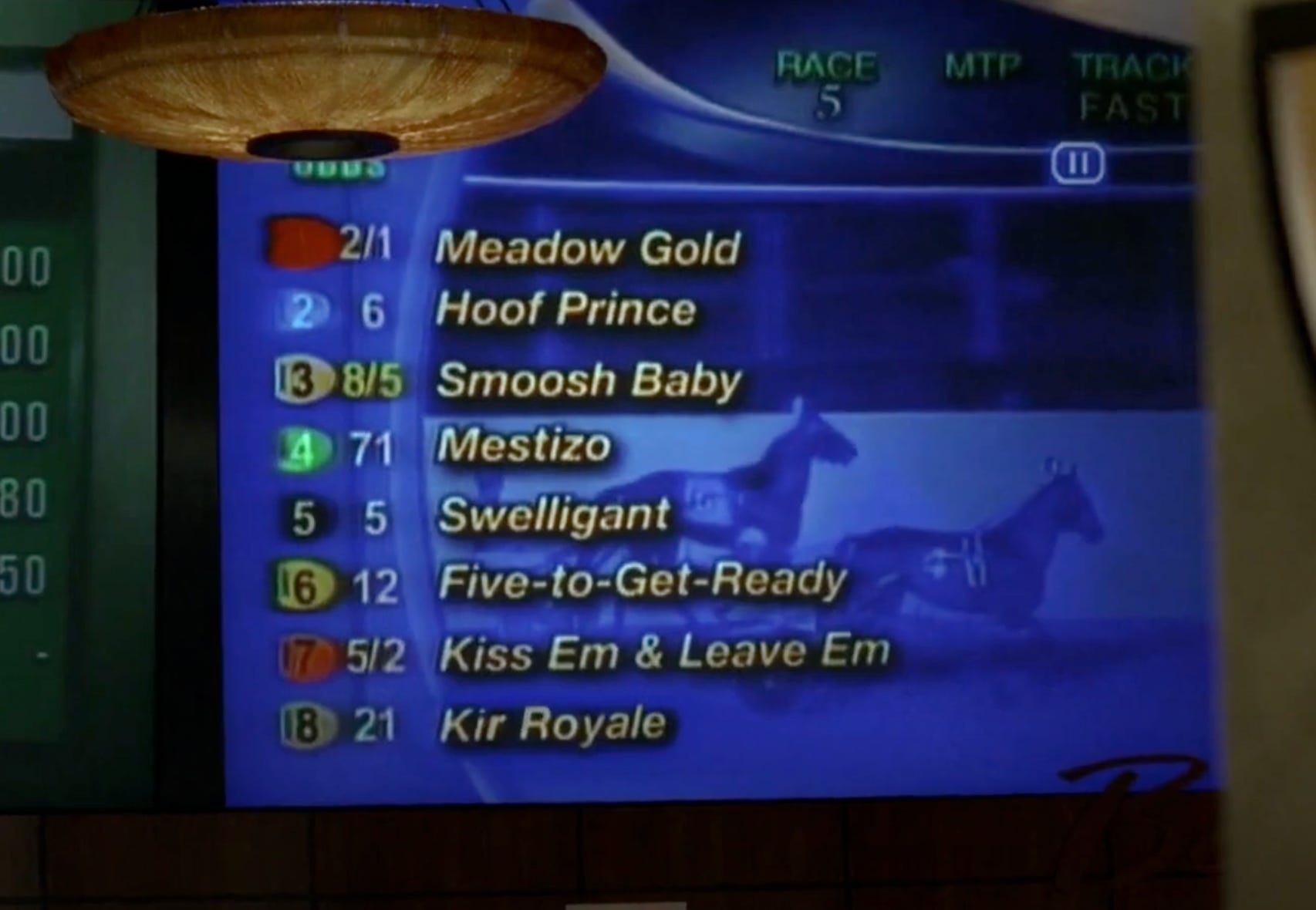
One last thing about “Chasing It”: I mentioned to Weiner the scene in which an upcoming horse race on TV catches Tony’s eye. “Coming up with a bunch of fake horse names was really, really hard because let me tell you, you think anything could be a horse name,” he said. “It’s not true. They could sound very phony.”
Here’s what he came up with:
The Kooky Historical Factoid File
I’VE BEEN SHARING some of the bizarre stories I came across in newspaper and magazine archives while researching my book. Previous editions covered a national obsession with trying to catch a baseball dropped from the top of the Washington Monument, a technique for swindling bartenders, and the perplexing rash of baseball-related deaths in the 1800s.
In keeping with this “Sopranos”-themed newsletter, today’s story takes us to New Jersey, specifically the town of Weehawken, just across the Hudson from New York City. The New York Times covered a baseball game there in May of 1884, and it reads like Dante describing the souls condemned to the ninth circle of hell.
A crowd of 7,000 gathered in Weehawken for a Sunday baseball game. “The majority of them,” The Times reported, “were about as hard a looking set as ever graced the cells of Sing Sing Prison. To a man they had their hair cut short, and all carried quids of tobacco that would strike terror in the heart of a jack tar. Their language was of the worst character, and often brought blushes to the cheeks of the few respectable persons who had occasion to take a trip to Weehawken.”
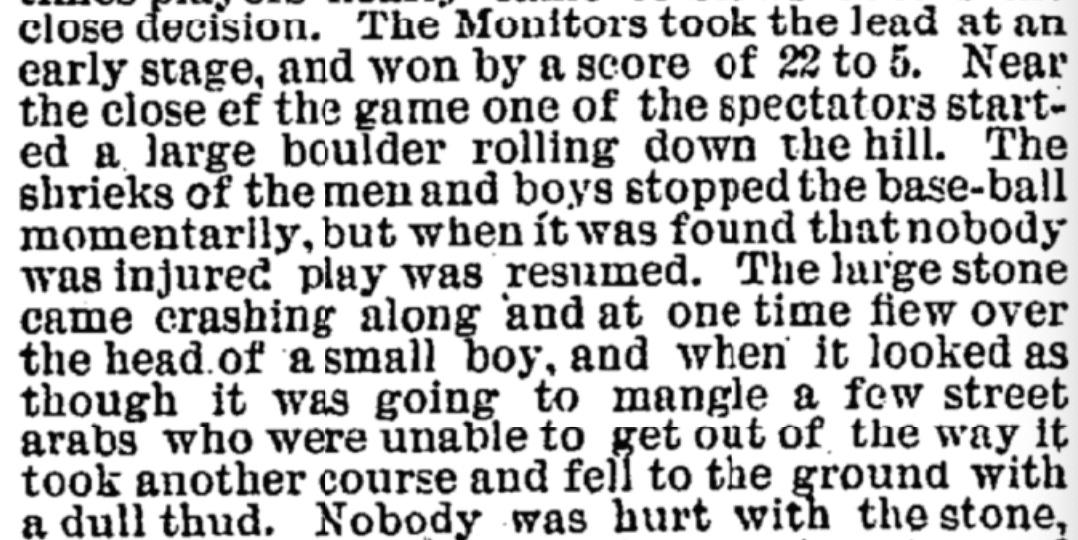
The reporter was also scandalized by all the gambling in the stands. The game itself wasn’t very suspenseful, until:
A few weeks later, The Times returned to Weehawken for another ballgame. In addition to the “vile” townsfolk who were on hand, about 5,000 New Yorkers came on ferries. Those boats, the newspaper reported, “might have been towed out into the bay and sank without any great loss to the community.”
Of these passengers, the story goes on:

(“Lees,” as in the sediment that collects in a bottle of wine, referred to the dregs of society. A “beanery” was a low-end restaurant.)
They arrived at Weehawken’s “wretched” beer gardens and saloons, where “a score of itinerant gamblers began their traffic.” A young man in a white high hat and plaid suit erected a table for shooting dice, and “two dyspeptic-looking gentlemen in damaged beavers and greasy-frock coats” set up a roulette wheel. The Times even took aim at “small and dirty boys and girls” operating lemonade stands under trees.
Unlike at the game in May, this time “determined looking men stepped up and tapped the gamblers on the shoulders and exhibited little pieces of engraved silver on their bosoms” before arresting the gamblers. Plainclothes officers from Jersey City were scattered in the “savage” crowd and arrested 31 people for gambling.
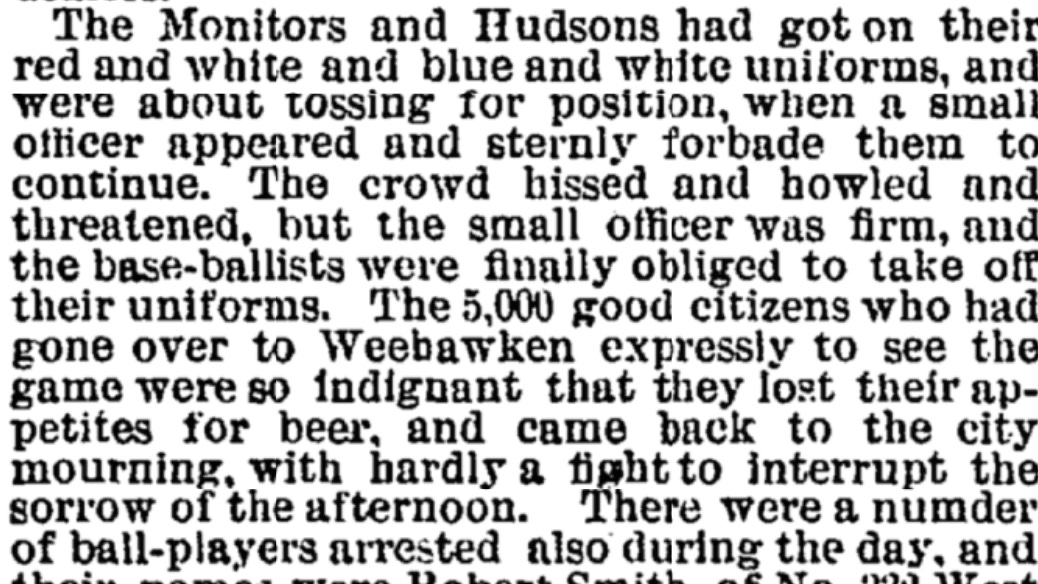
There were plenty of wagers placed on the upcoming baseball game, too, and the cops weren’t having it:
I get that gambling was illegal back then, but this coverage of Weehawken seems a wee bit harsh.
Thank you all for reading. I’m especially grateful to everyone who has preordered my book, which is just three months from publication! Preorders make a big difference, so if you haven’t, please consider securing a copy through any of the retailers listed here.
By the way, the CNN sports betting documentary for which I was interviewed is now streamable on HBO Max. I was delighted that they included a clip of me explaining why we titled the book “Everybody Loses.”
Wynnie found it pretty eye-opening.
