
Today's the day!
"Everybody Loses: The Tumultuous Rise of American Sports Gambling" is available wherever you buy books.

I WROTE THIS BOOK BECAUSE I BELIEVE SPORTS FANS—and really all Americans—deserve answers to basic questions that the people behind the betting boom have largely avoided.
Are leagues and law enforcement equipped to stop gambling from corrupting sports?
Does legalization pull sports gamblers from the black market, or does it just grow the pool of people betting both legally and illegally?
In exchange for all the money that sportsbooks and leagues are making from legalization, how much harassment of athletes, coaches, and referees are we willing to tolerate? How many gambling addictions that wouldn’t have developed otherwise? How many suicides?
Americans have been cheated out of the sort of robust national debate that legalizing sports betting across the country would seem to warrant. I hope Everybody Loses: The Tumultuous Rise of American Sports Gambling forces people to engage in that conversation.
The leagues, which raced to extract every possible dollar from legalization after a century of fiercely opposing it, rarely give interviews about gambling policy. Sportsbooks—especially the two market leaders, FanDuel and DraftKings—rarely give interviews about anything that isn’t promotional. Still, when I set out to report this book, I was optimistic that I’d get to speak with sportsbook executives and league commissioners.
But I was determined to shed light on how this industry really works, and how it thinks about customers, with or without their cooperation.
A reporting trip to New York is illustrative of what ended up happening. One of the first people I met that week was Chris Jones, then VP of communications at FanDuel. I believed we were meeting to plan various interviews that he’d help arrange. But over the next 45 minutes, Jones explained why FanDuel would not be participating in my book. (He asked that I not share his reasons.)
Afterward, I hustled across town to meet Nik Bonaddio, the former head of product at FanDuel. He was surprisingly reflective about his time there, conceding how “shitty” it was to offer misleading “risk-free” promotions and how he suspects that the vast majority of customers fail to understand that the house edge is considerably bigger on parlays, sportsbooks’ biggest moneymaker.
Two days later, I took the train to the commuter town of Mamaroneck, home of Nigel Eccles, FanDuel’s founding CEO. He, too, spoke expansively, expressing dismay about the trajectory of the sports betting industry. “I think their advertising is untruthful,” he said of American sportsbooks, including his former company. “They’re selling that you can win, but you can’t.”
Toward the end of my trip, I met with Jessica Leeser, who had served as FanDuel’s director of brand and marketing insights. She shared revealing takeaways from internal customer surveys. For example, many of FanDuel’s customers said they were disinclined to recommend the app—not because they didn’t like the user experience, but because they were reluctant to admit they gamble. “Maybe there is some shame attached to it,” Leeser said, “or some embarrassment.”
Over the ensuing months, I spoke with many other former and active employees at FanDuel, as well as at all the other top sportsbooks. (DraftKings was similarly uncooperative. I wasn’t even granted an interview with the person appointed, to much fanfare, as the industry’s first chief responsible gaming officer.)
There are, to be sure, many people in the betting industry who insist sports gambling is perfectly safe and that customers are treated fairly. But the overall impression I gathered from interviewing more than 300 people is that sportsbooks are brazenly taking advantage of customers, and, in some cases, outright endangering them.
A cautionary note from a former sportsbook executive sums that up. “You can make good money,” he told me, “but you don’t feel good about it, that’s for sure.”
I’M PROUD OF THE FACT that Everybody Loses offers an unprecedented look inside the betting industry, in spite of these top operators declining to cooperate. In turn, I’m enormously grateful that so many people were generous enough—and, in some cases, brave enough—to speak with me.
I’m indebted to people of many backgrounds—athletes, agents, politicians, lobbyists, lawyers, scholars, gambling counselors, bettors of all types, etc.—who gave me so much of their time and entrusted me with their stories. In particular, it means a lot that people shared what it’s like to experience gambling addiction. (If you missed it, Vanity Fair published an excerpt on that subject last week.)
Some of the issues investigated in this book are grave or even dire. But I also found a lot of it fascinating, as I hope you do, too: how sportsbooks profile customers to tell “sharps” from “squares,” how they lavish “VIP” customers with the most unbelievable perks imaginable, how professional bettors go to phenomenal lengths to get around wagering limits, and so much else.
It’s hard to believe the book is finally on sale. I can’t wait to hear what people think.
Here is a link to Simon & Schuster’s page listing places it can be ordered. Anything you’re able to do to help spread the word is hugely appreciated, especially sharing that S&S link on social media—there’s an image of the cover, below, to help with that—and telling people about the book who might be interested. If you order (or preordered) through an online retailer, please rate and review it when you get a chance. That makes a big difference.

It was an incredible feeling yesterday to be driving my son to daycare and hear my interview on the NPR program “Morning Edition.” I’ve had a wonderful time discussing the book recently, including a great conversation on the podcast hosted by Dave Zirin, sports editor of The Nation. And Henry Abbott, the esteemed basketball writer, published a Q&A with me on his newsletter.
Writing a book was daunting at times. Just as daunting will be finding adequate words to thank all the people who made it possible.
There’s much more to come. Wynnie was a wonderful friend while I worked on the book—in Fort Collins, then Charlotte—keeping me company on my desk. I just hope she doesn’t demand her spot on my keyboard when I’m being interviewed this week.
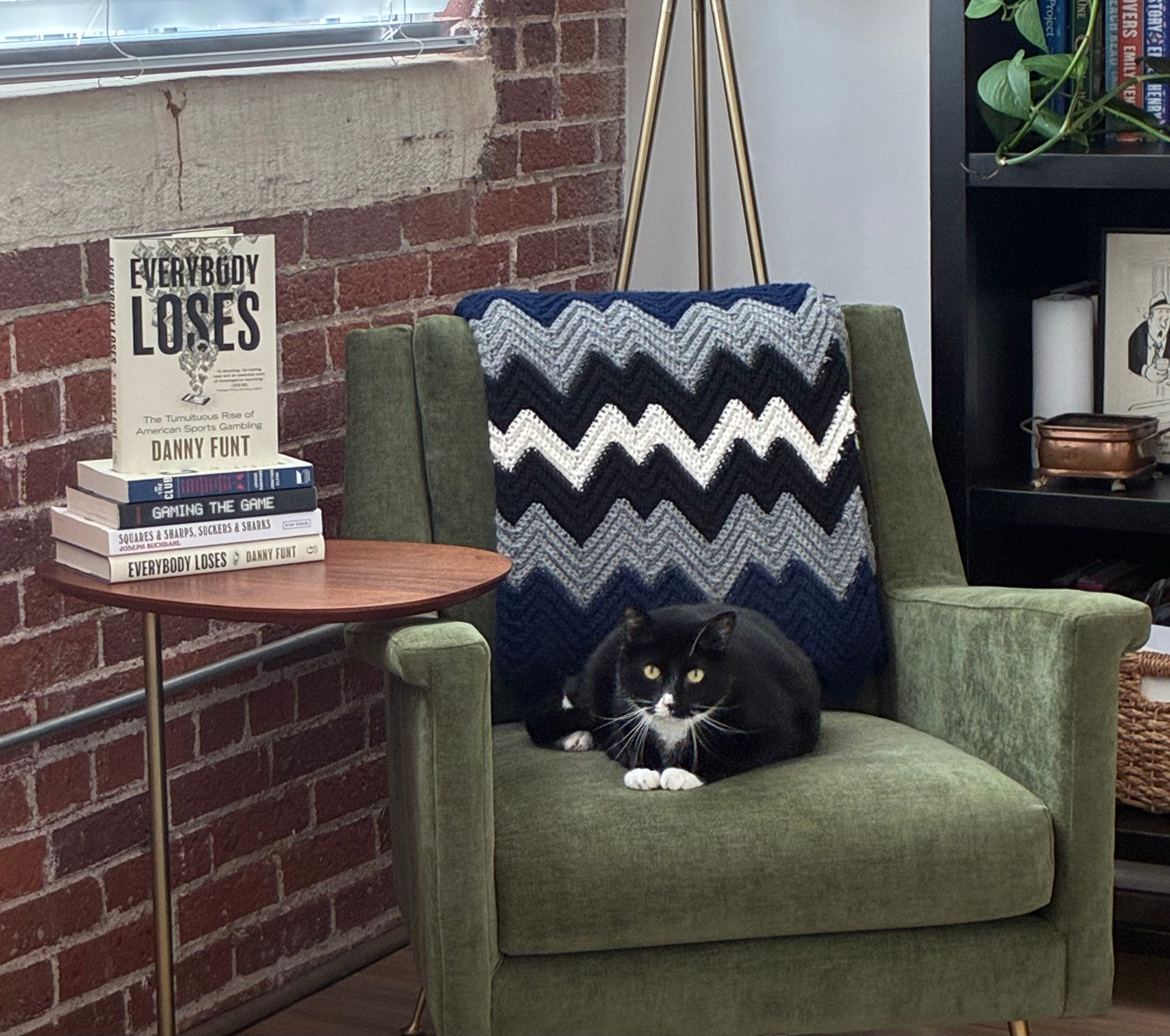
So excited that it's finally here!
Congratulations!